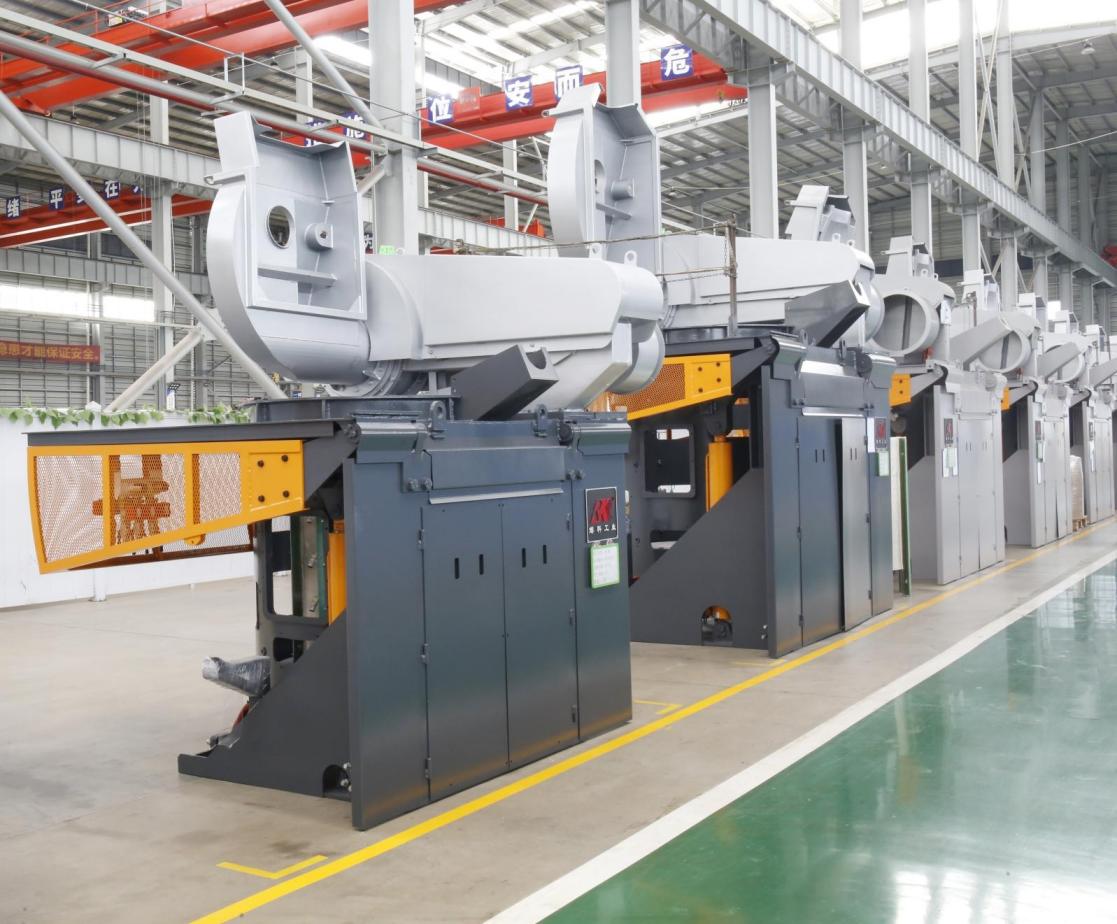


Medium Frequency vs. High Frequency Induction Furnace: What’s the Difference?
Medium Frequency vs. High Frequency Induction Furnace: What’s the Difference?
When choosing an induction heating or melting system, one of the most important technical factors to consider is operating frequency.
You may have seen terms such as:
- Medium frequency induction furnace
- High frequency induction furnace
- Low frequency induction furnace
But what is the difference between them?
Does a higher frequency always mean better performance?
Not necessarily.
The most suitable frequency depends on the application, material, workpiece size, furnace capacity, required heating depth, melting process, and production requirements.
In this guide, we compare medium frequency and high frequency induction systems and explain how to choose the right solution for your application.
1. What Is Induction Heating Frequency?
An induction power supply sends alternating current through an induction coil.
The alternating current creates an electromagnetic field, which induces electrical currents inside the conductive material.
These induced currents generate heat.
The frequency of the alternating current affects how the electromagnetic field interacts with the material.
In general:
Higher frequency → Shallower heating penetration
Lower frequency → Deeper heating penetration
This is one of the key principles behind induction system frequency selection.
However, actual heating performance also depends on factors such as:
- Material properties
- Workpiece size
- Coil design
- Power density
- Heating temperature
- Furnace configuration
- Operating conditions
Therefore, frequency should always be selected together with the complete system design.
2. What Is a Medium Frequency Induction Furnace?
A medium frequency induction furnace is an induction melting system designed to operate within a medium-frequency range.
Medium-frequency systems are widely used for industrial metal melting applications because they provide a practical balance between:
- Melting efficiency
- Heating penetration
- Electromagnetic stirring
- Production flexibility
- Equipment size
They are commonly used in foundries for melting materials such as:
- Cast iron
- Carbon steel
- Stainless steel
- Copper
- Other metal alloys
The exact frequency and power configuration should be selected according to the furnace capacity and application.
3. What Is a High Frequency Induction Furnace?
A high frequency induction system operates at a higher electrical frequency.
As frequency increases, the induced current tends to concentrate closer to the surface of the material. This phenomenon is commonly associated with the skin effect.
High-frequency induction heating is therefore often useful when the application requires:
- Surface heating
- Rapid localized heating
- Heat treatment
- Brazing
- Hardening
- Heating relatively small components
The best frequency depends on the required heating depth and production process.
4. Medium Frequency vs. High Frequency: Key Differences
The easiest way to understand the difference is to compare their typical applications.
| Factor | Medium Frequency | High Frequency |
|---|---|---|
| Typical application | Metal melting and industrial heating | Surface/localized heating |
| Heating penetration | Generally deeper | Generally shallower |
| Typical workpiece | Larger metal charge | Smaller or localized workpiece |
| Common application | Foundries | Heat treatment, brazing, hardening |
| Electromagnetic stirring | Important in melting | Usually less relevant for bulk melting |
| Furnace application | Widely used | More application-specific |
| Main consideration | Melting capacity and efficiency | Heating depth and heating speed |
This table provides a general comparison.
The actual performance of an induction system depends on its complete electrical, mechanical, and thermal design.
5. Why Is Medium Frequency Commonly Used for Metal Melting?
For foundry applications, the objective is usually to heat and melt a relatively large amount of metal.
The system therefore needs to transfer energy effectively throughout the metal charge.
Medium-frequency induction systems can provide a suitable combination of:
- Heating penetration
- Power density
- Electromagnetic stirring
- Melting speed
- Operational flexibility
The electromagnetic stirring effect can also help promote mixing within the molten metal.
This can contribute to more uniform temperature and composition when the process is properly controlled.
For these reasons, medium-frequency induction furnaces are widely used in industrial foundries.
6. Does Higher Frequency Mean Faster Melting?
This is a common misconception.
Higher frequency does not automatically mean faster melting.
Melting performance depends on many factors, including:
- Available power
- Furnace capacity
- Metal type
- Charge density
- Coil design
- Electrical efficiency
- Melting temperature
- Furnace operating conditions
For example, a properly designed medium-frequency melting system can be highly effective for melting large quantities of metal.
Therefore, the correct question is not:
“Which frequency is higher?”
The better question is:
“Which frequency is suitable for my application?”
7. Medium Frequency for Foundry Melting
If your main application is melting metal in a foundry, medium frequency is often an appropriate solution.
A typical system may include:
Medium-Frequency Power Supply
↓
Induction Coil
↓
Furnace Crucible
↓
Metal Charge
↓
Molten Metal
The system can also be integrated with other foundry equipment.
For example:
Automatic Batching & Feeding
↓
Induction Melting
↓
Molten Iron Transfer
↓
Automatic Pouring
This allows the induction furnace to become part of a complete automated foundry production line.
8. High Frequency for Localized Heating
High-frequency induction systems are often more suitable when the goal is not to melt a large quantity of metal but to heat a specific area.
Typical applications can include:
- Surface hardening
- Heat treatment
- Brazing
- Soldering
- Localized heating
- Heating small metal components
Because the heating effect is more concentrated near the surface, high frequency can be useful when precise localized heating is required.
9. How to Choose the Right Frequency?
When selecting an induction system, consider the following questions.
What Is Your Application?
Are you:
- Melting metal?
- Heating metal?
- Hardening a component?
- Brazing?
- Heat treating?
The application should be the starting point.
What Is the Material?
Different materials have different electrical and thermal properties.
You should provide the manufacturer with the exact material or alloy whenever possible.
What Is the Size of the Charge or Workpiece?
Large metal charges and small components have very different heating requirements.
How Much Material Do You Need to Process?
For melting applications, consider:
- Furnace capacity
- Tons per batch
- Tons per hour
- Required melting cycle
What Heating Depth Do You Need?
If you need deep heating throughout a large metal charge, the frequency selection will be different from an application requiring only surface heating.
What Is Your Production Target?
A system designed for laboratory or small-batch production will have different requirements from a high-volume industrial production line.
10. Frequency Is Only One Part of the System
When purchasing an induction furnace, do not evaluate the equipment based only on frequency.
Other important factors include:
Power
The available power affects the melting rate and production capacity.
Coil Design
The coil must be designed according to the furnace capacity and application.
Furnace Capacity
The furnace should match your required batch size and production process.
Cooling System
The induction coil and electrical components require reliable cooling.
Refractory Lining
The lining must be suitable for the metal and operating temperature.
Control System
Accurate monitoring and control can improve operational stability.
Safety
A complete industrial system should include appropriate electrical protection, cooling protection, temperature monitoring, and furnace leakage detection.
Automation
For modern foundries, automation can connect:
Material Batching → Feeding → Melting → Transfer → Pouring
The best solution considers all of these factors together.
11. Medium Frequency vs. High Frequency: Which One Should You Choose?
There is no universal answer.
Choose Medium Frequency When:
You are primarily looking for:
- Metal melting
- Foundry production
- Larger metal charges
- Electromagnetic stirring
- Industrial melting efficiency
- Integration with automated foundry systems
Consider High Frequency When:
Your application focuses on:
- Surface heating
- Localized heating
- Hardening
- Brazing
- Heat treatment
- Smaller components
However, these are general guidelines.
The final frequency should be determined by an experienced induction system manufacturer after evaluating your specific application.
12. Rongke’s Medium-Frequency Induction Melting Solutions
Rongke specializes in industrial induction melting and foundry automation solutions.
For customers who need metal melting systems, Rongke can provide solutions involving:
- Medium-frequency induction melting furnaces
- Medium-frequency power supply systems
- Automatic batching and feeding systems
- Molten iron transfer systems
- Automatic pouring systems
- Cooling systems
- Dust removal systems
- Related control and automation equipment
The recommended configuration depends on:
Metal Type + Furnace Capacity + Required Melting Rate + Production Process + Automation Requirements
Instead of choosing a frequency based only on a single specification, Rongke’s engineering team evaluates the complete production requirement and develops a suitable system configuration.
Conclusion
The difference between medium-frequency and high-frequency induction systems is not simply that one frequency is “better” than the other.
The right frequency depends on the application.
Medium frequency is widely used for industrial metal melting because it offers a practical combination of heating penetration, melting efficiency, electromagnetic stirring, and production flexibility.
High frequency is often more suitable for localized heating, surface hardening, brazing, and other applications where concentrated heating is required.
Before purchasing an induction system, consider:
- Material type
- Application
- Furnace or workpiece size
- Required heating depth
- Production capacity
- Power requirements
- Coil design
- Automation requirements
Choosing the correct frequency as part of a properly engineered system can help improve production performance and operating efficiency.
Need Help Choosing the Right Induction System?
Tell us your:
- Metal type
- Furnace capacity
- Required melting rate
- Production process
- Automation requirements
Rongke’s engineering team can help you evaluate your requirements and develop a suitable induction melting solution.