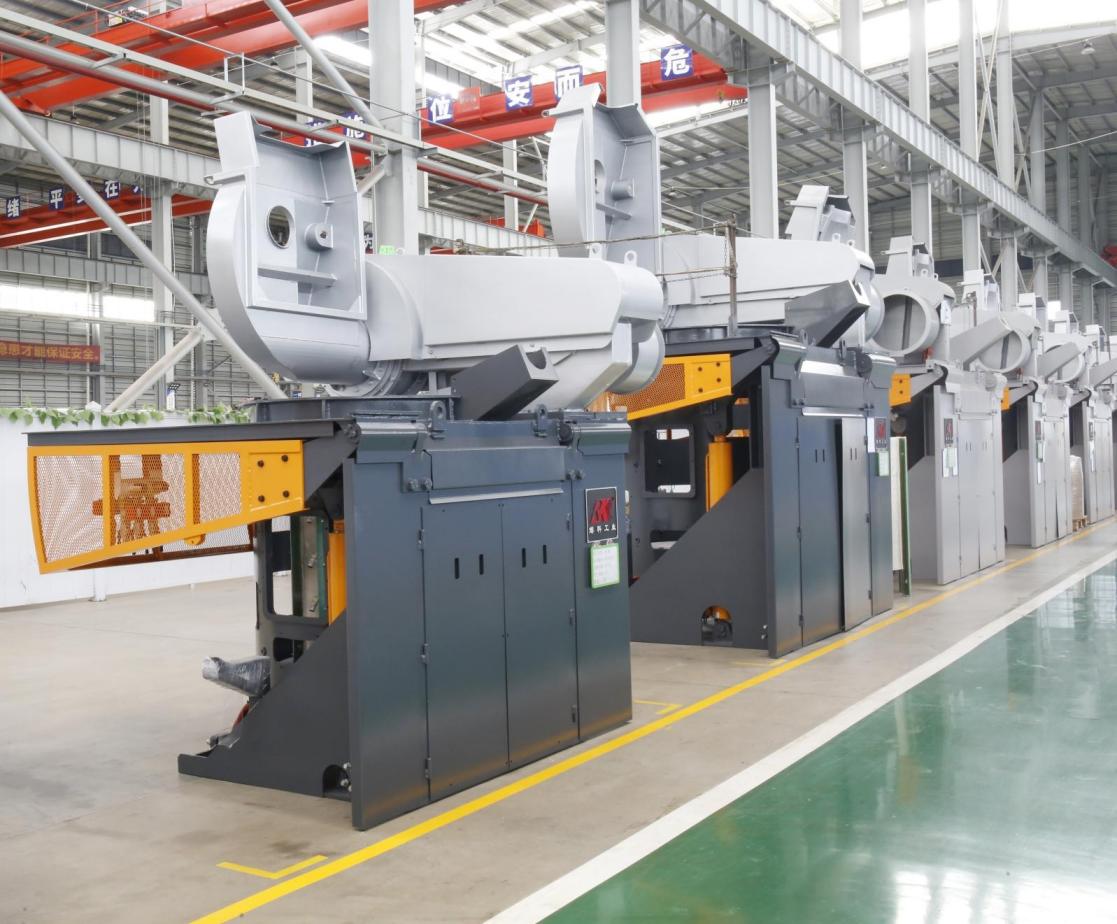


How Does an Induction Melting Furnace Work?
An induction melting furnace is widely used in foundries and metal-processing industries to efficiently melt metals such as cast iron, steel, copper, aluminum, and other alloys.
But how does an induction melting furnace actually work?
Unlike conventional fuel-fired furnaces, an induction melting furnace uses electromagnetic induction to generate heat directly inside the metal. This allows the furnace to achieve fast melting, precise temperature control, clean operation, and high energy efficiency.
In this article, we explain the working principle of an induction melting furnace, its main components, the melting process, and the key factors to consider when selecting an induction furnace for your foundry.
- What Is an Induction Melting Furnace?
An induction melting furnace is an electric furnace that melts metal using electromagnetic induction.
The basic system consists of several key components:
- Induction furnace body
- Induction coil
- Medium-frequency power supply
- Capacitor and electrical control system
- Cooling system
- Hydraulic tilting system
- Temperature measurement and control system
- Safety and furnace leakage protection system
The power supply converts electrical energy into a suitable alternating current. This current flows through the induction coil and creates an alternating electromagnetic field.
When conductive metal is placed inside the coil, the electromagnetic field induces electrical currents within the metal. These currents generate heat, causing the metal to melt.
In simple terms:
Electrical Energy → Alternating Current → Electromagnetic Field → Induced Current → Heat → Molten Metal
This is the fundamental working principle of an induction melting furnace.
⸻
- How Does Electromagnetic Induction Melt Metal?
The key technology behind induction melting is electromagnetic induction.
When alternating current passes through the induction coil, it produces a changing magnetic field.
The metal charge inside the coil is exposed to this changing magnetic field. According to the principles of electromagnetic induction, electrical currents are generated inside the metal.
These induced currents are commonly known as eddy currents.
The electrical resistance of the metal causes the eddy currents to generate heat.
As the temperature increases, the metal gradually changes from a solid state into a liquid state.
The process can be simplified as:
AC Power → Coil → Magnetic Field → Eddy Currents in Metal → Resistance Heating → Melting
One important advantage is that the heat is generated within the metal itself rather than being transferred from an external flame or heating element.
⸻
- Main Components of an Induction Melting Furnace
3.1 Induction Coil
The induction coil is one of the most important components of the furnace.
Usually made from specially designed copper tubing, the coil carries alternating current and generates the electromagnetic field required for induction heating.
The design of the coil affects:
- Heating efficiency
- Melting speed
- Electrical performance
- Magnetic field distribution
- Furnace capacity
- Overall system reliability
For this reason, coil design should be matched to the furnace capacity, metal type, operating frequency, and required melting performance.
3.2 Medium-Frequency Power Supply
The power supply provides the electrical energy required for induction melting.
For industrial induction melting applications, medium-frequency power supplies are widely used because they provide a suitable balance between melting efficiency, penetration depth, stirring effect, and system performance.
Depending on the furnace design and application, different power supply technologies can be selected.
The appropriate power level depends on factors such as:
- Furnace capacity
- Metal type
- Required melting rate
- Production schedule
- Available electrical infrastructure
- Target energy consumption
3.3 Furnace Crucible
The crucible is the part of the furnace where the metal charge is melted.
The lining material must be selected according to the metal being melted and the operating conditions.
Important considerations include:
- Operating temperature
- Chemical compatibility
- Thermal shock resistance
- Mechanical strength
- Lining thickness
- Maintenance requirements
Proper lining installation and maintenance are essential for safe and efficient operation.
3.4 Cooling System
Induction furnaces generate significant heat during operation.
The induction coil and other electrical components therefore require an effective cooling system.
A properly designed cooling system helps maintain stable operating temperatures and protects critical components from overheating.
3.5 Tilting System
After the metal has reached the required temperature and composition, the furnace needs to discharge the molten metal.
A hydraulic or mechanical tilting system allows the furnace body to tilt and pour molten metal into a ladle or downstream production system.
For automated foundries, the furnace can also be integrated with molten iron transfer and automatic pouring systems.
⸻
- What Is the Induction Melting Process?
The complete melting process can generally be divided into several stages.
Step 1: Charge the Raw Materials
Metal scrap, returns, ingots, or other raw materials are loaded into the furnace.
The charge composition depends on the required final metal grade.
For automated foundries, an automatic batching and feeding system can be used to weigh, mix, and charge different materials according to a predefined recipe.
Step 2: Start the Induction Power Supply
Once the furnace is properly charged, the induction power supply is activated.
Alternating current flows through the induction coil, generating an electromagnetic field.
Step 3: Generate Eddy Currents
The electromagnetic field induces electrical currents inside the metal charge.
The resistance of the metal converts electrical energy into thermal energy.
The metal begins to heat rapidly.
Step 4: Metal Melting
As the temperature continues to rise, the solid metal gradually becomes molten.
Electromagnetic stirring also occurs during the process.
This stirring can help improve the uniformity of the molten metal and promote mixing of the metal bath.
Step 5: Temperature and Composition Control
Once the metal is molten, operators can check the temperature and chemical composition.
Depending on the application, alloying elements may be added to achieve the required material grade.
For precision foundry production, temperature control and chemical composition are particularly important.
Step 6: Pouring
After the molten metal reaches the required temperature and composition, it can be transferred to the next stage.
The furnace may be tilted to discharge the molten metal into a ladle.
In a more automated production line, the melting furnace can be connected with:
Automatic Batching → Feeding → Melting → Molten Metal Transfer → Automatic Pouring
This creates a more integrated foundry production process.
⸻
- Why Are Induction Melting Furnaces Widely Used?
Induction melting technology offers several advantages compared with conventional melting methods.
Fast Melting
Because heat is generated directly inside the metal, induction melting can achieve high heating and melting rates.
The actual melting performance depends on furnace capacity, power, metal type, charge condition, and operating parameters.
High Energy Efficiency
Induction heating does not require combustion to transfer heat from a flame to the metal.
Electrical energy is converted into electromagnetic energy and then directly into heat inside the charge.
This can provide high energy efficiency when the system is properly designed and operated.
Precise Temperature Control
Electrical power can be controlled accurately, making it easier to manage the temperature of the molten metal.
This is particularly important for foundries producing different grades of castings.
Clean Melting Environment
Unlike fuel-fired furnaces, induction furnaces do not require direct combustion inside the melting chamber.
This can help create a cleaner production environment and reduce combustion-related emissions.
However, melting itself can still generate fumes and dust depending on the raw materials and metal being processed, so an appropriate dust and fume extraction system may be required.
Electromagnetic Stirring
The electromagnetic field produces a stirring effect within the molten metal.
This can help improve temperature and composition uniformity when the process is properly controlled.
Flexible Production
Induction furnaces are available in different capacities and power configurations.
This makes them suitable for a wide range of applications, from relatively small foundries to large-scale industrial melting operations.
⸻
- What Metals Can Be Melted in an Induction Furnace?
Induction melting furnaces can be designed for different types of conductive metals.
Common applications include:
Cast Iron
Induction furnaces are widely used for melting cast iron in foundries.
They can be integrated with automated charging, temperature control, molten iron transfer, and pouring systems.
Steel
Induction melting is also widely used for steel melting and alloy production.
The furnace configuration and lining must be selected according to the steel grade and operating temperature.
Copper
Copper and copper alloys can be melted using properly designed induction systems.
Aluminum
Induction heating can also be used for aluminum melting, although furnace design, frequency, lining, and temperature control need to be selected according to the application.
The important point is that one furnace configuration is not necessarily suitable for every metal or production requirement.
The furnace capacity, power, frequency, coil design, refractory lining, cooling system, and automation level should all be considered together.
⸻
- How to Choose the Right Induction Melting Furnace?
When selecting an induction melting furnace, buyers should consider more than just the furnace capacity.
- Metal Type
What material will you melt?
- Cast iron
- Carbon steel
- Stainless steel
- Copper
- Aluminum
- Other alloys
Different metals have different melting temperatures and processing requirements.
- Required Melting Capacity
Determine how much metal you need to melt per batch and how much metal you need to produce per hour.
For example:
Furnace Capacity ≠ Hourly Production Capacity
A 2-ton furnace does not automatically mean 2 tons of production per hour.
Melting time, charging method, power level, operating efficiency, tapping time, and production cycle all affect actual output.
- Required Power
The appropriate power level should be determined based on:
- Furnace capacity
- Metal type
- Melting rate
- Production target
- Electrical conditions
An experienced furnace manufacturer can calculate the appropriate configuration based on your specific production requirements.
- Automation Level
A basic induction melting system may only include the furnace and power supply.
A modern foundry may require a complete automated solution:
Automatic Batching & Feeding
↓
Induction Melting
↓
Molten Metal Transfer
↓
Automatic Pouring
↓
Casting Production
The right solution depends on your production volume, labor costs, factory layout, and automation requirements.
- Safety
Safety should be one of the highest priorities when purchasing an induction melting system.
Important safety considerations include:
- Furnace leakage detection
- Cooling system monitoring
- Electrical protection
- Hydraulic system protection
- Temperature monitoring
- Emergency shutdown
- Proper refractory lining
- Appropriate fume and dust extraction
A professional induction furnace manufacturer should provide a complete safety system rather than focusing only on melting performance.
⸻
- Induction Melting Furnace from Rongke
Rongke provides induction melting and foundry automation solutions for different industrial applications.
Our solutions can cover the complete production process from material preparation to molten metal pouring.
Depending on the customer’s requirements, a system can include:
- Medium frequency induction melting furnace
- Medium frequency power supply
- Automatic batching and feeding system
- Molten iron transfer system
- Automatic pouring system
- Cooling system
- Dust removal system
- Related control and automation equipment
Instead of simply supplying a standard furnace, Rongke can develop the equipment configuration according to factors such as:
Metal Type + Furnace Capacity + Melting Rate + Factory Layout + Automation Requirements
This approach helps customers select a melting system that matches their actual production requirements.
⸻
- Conclusion
An induction melting furnace works by using electromagnetic induction to generate heat directly inside conductive metal.
The basic process is:
Electrical Power → Induction Coil → Electromagnetic Field → Eddy Currents → Heat → Metal Melting
Compared with traditional melting methods, induction furnaces can provide fast melting, precise temperature control, electromagnetic stirring, flexible operation, and efficient energy utilization.
However, choosing the right induction furnace requires more than selecting a furnace capacity. Metal type, production requirements, power supply, refractory lining, cooling system, safety systems, and automation should all be considered.
For foundries looking to improve production efficiency, an induction melting furnace can also be integrated with automatic batching, feeding, molten metal transfer, and pouring systems to create a more complete automated melting solution.
Looking for the Right Induction Melting Furnace?
If you are planning a new foundry, upgrading an existing melting line, or looking for a customized induction melting solution, Rongke’s engineering team can help evaluate your requirements and recommend a suitable system.
Contact Rongke to discuss your metal type, furnace capacity, melting target, and automation requirements.